
February 24 - Judges 12-16
The life of Samson stands as one of the most fascinating and tragic accounts in the Book of Judges. He is remembered both as a mighty deliverer and as a morally weak man. His story demonstrates a powerful spiritual truth: a person can be chosen by God and yet still struggle with the flesh and spiritual compromise eventually brings spiritual collapse. Yet even in failure, God’s mercy and sovereignty prevail.
Samson’s life may be understood in four movements: his miraculous birth, his compromised calling, his captivity through sin, and his final repentance and victory.
A Miraculous Birth — A Man Set Apart (Judges 13)
Israel was under oppression by the Philistines because of their repeated disobedience to God. As in the recurring pattern of Judges, the people sinned, God allowed oppression, and then God raised a deliverer. Into this dark spiritual period, Samson was born. An angel of the LORD appeared to Manoah’s barren wife and declared: “For behold, you shall conceive and bear a son. And no razor shall come upon his head, for the child shall be a Nazirite to God from the womb; and he shall begin to deliver Israel out of the hand of the Philistines.” (Judges 13:5)
Samson was a Nazirite from birth. This vow symbolized total separation unto God. His uncut hair was not magical but an outward sign of inward consecration. Samson’s strength came from the Spirit of the LORD, not from his muscles. I don’t envision Samson being strong in appearance. I suspect that he looked like an ordinary man. That’s why people were baffled by his strength. It was not natural; it was supernatural.
A Compromised Calling — Strength Without Self-Control (Judges 14–15)
As Samson grew, we discover his greatest weakness: he was ruled by his eyes and appetites instead of by God’s Word.
Samson saw a Philistine woman and demanded: “Get her for me, for she pleases me well” (Judges 14:3). Israel was commanded not to intermarry with pagan nations (Deuteronomy 7:3-4), yet Samson ignored God’s command because of desire. This becomes the pattern of his life. While Samson could always defeat his enemies, he constantly loses battles with his flesh. His failure to avoid temptation eventually led to his demise.
Captivity Through Sin — The Fall of a Strong Man (Judges 16:1-21)
Samson’s greatest enemy was not the Philistines but his unrestrained desires. Judges 16 opens with Samson visiting a harlot in Gaza. Though he escaped the Philistines physically, spiritually he was drifting farther from God.
Then came Delilah. Delilah repeatedly asked Samson the source of his strength. Three times he lied. Each time she tested him, and each time he stayed. Instead of fleeing temptation, he lingered near it. Sin dulls spiritual sensitivity. Eventually: “He told her all his heart” (Judges 16:17). He revealed his Nazirite vow. Delilah cut his hair.
“But he did not know that the LORD had departed from him” (Judges 16:20). Samson assumed God’s power would remain regardless of his obedience. He mistook God’s patience for God’s approval.
The Philistines captured him, gouged out his eyes, and made him grind grain in prison. The man who followed his eyes lost his eyes. The man who lived for pleasure became a slave. Sin blinds, binds, and grinds.
Repentance and Final Victory — Strength Restored (Judges 16:22-31)
One small but hopeful verse appears: “However, the hair of his head began to grow again” (Judges 16:22). This was more than physical; it symbolized returning consecration. In prison, Samson finally turned back to God. For the first time in Scripture, Samson prays sincerely: “O Lord GOD, remember me, I pray! Strengthen me, I pray, just this once” (Judges 16:28).
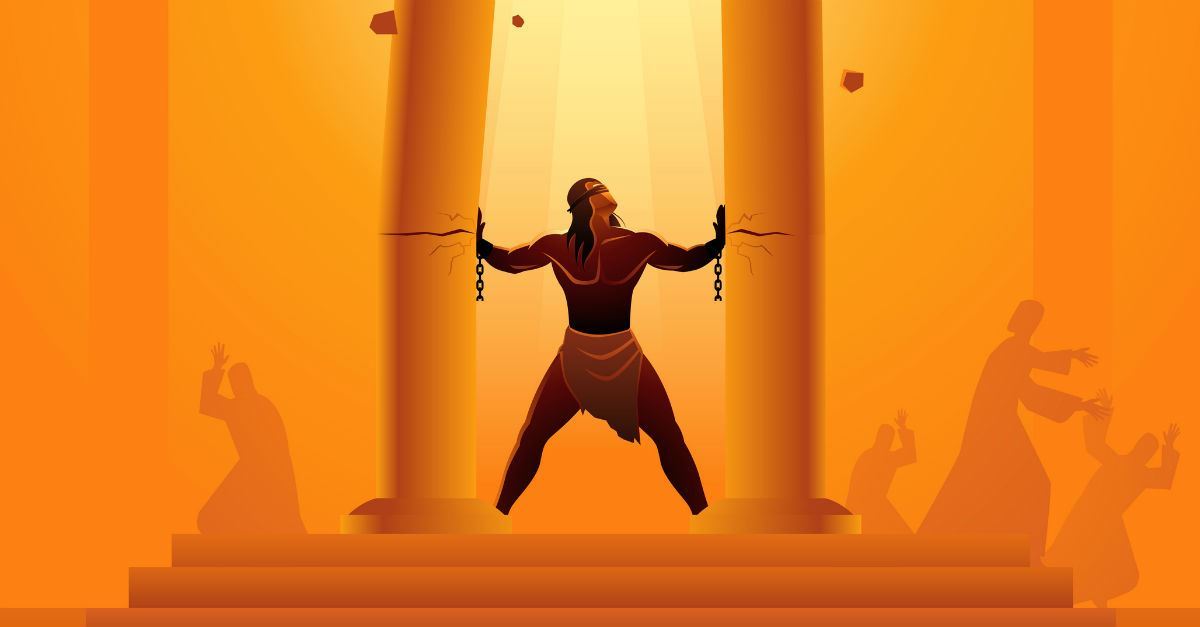
Previously Samson relied on himself. Now he relied on God. The Philistines gathered in a temple to celebrate their god Dagon defeating Samson. They mocked him publicly. But God would have the final word. Samson pushed the pillars, collapsing the temple. “So the dead that he killed at his death were more than he had killed in his life” (Judges 16:30). His greatest victory came after repentance.
Samson’s life is a mirror of many believers: empowered by God but weakened by compromise. He teaches that strength without holiness becomes destruction, but repentance restores usefulness.
His story is both warning and hope. Warning: A strong beginning does not guarantee a strong finish. Hope: A broken life can still be redeemed. In the end, Samson accomplished God’s purpose, but only after surrendering himself completely.